Skip to content
F7 Air filter have quietly shifted from an optional upgrade to the absolute baseline for commercial indoor air quality. If you are managing HVAC systems, navigating green building certifications, or optimizing fan energy budgets, understanding how this specific grade performs under modern testing frameworks is essential.
Here is a practical breakdown of what F7 Air filter actually do, how they are tested, and where they make the most sense financially and operationally.
Defining the F7 Grade
The term “F7” comes from the legacy European standard EN 779, where the “F” stood for fine dust. To hit that rating, a filter had to capture 80% to 90% of 0.4-micron particles during laboratory testing.
While many engineers still use the term F7 out of habit, the global industry has moved to newer standards that look at real-world particle sizes rather than a single laboratory aerosol:
- ISO 16890: Under this framework, a classic F7 Air filter maps directly to ISO ePM2.5 65%. This means it reliably traps at least 65% of fine particulate matter under 2.5 microns, both when brand new and after it has been loaded with dust.
- ASHRAE 52.2: For North American projects, the closest functional equivalent is a MERV 13 filter.
This specific efficiency range is highly relevant right now because it aligns perfectly with the minimum requirements for LEED v4.1 Enhanced IAQ credits, WELL v2 Feature A05, and the newer ASHRAE Standard 241 for equivalent clean airflow targets.
Performance Metrics: The Engineering Reality
When evaluating an F7 Air filter for a project, the data sheet tells the real story. There are four main metrics that dictate how the filter will behave in an air handling unit (AHU):
Initial Pressure Drop (ΔP): A well-designed F7 Air filter typically starts between 70 and 90 Pascals (Pa) at standard face velocities. If you use mini-pleat cassettes, that can sometimes drop into the mid-60 Pa range. This low initial resistance is why F7 is favored over higher grades like F9 when fan power is limited.
Dust-Holding Capacity: This determines your actual maintenance intervals. Traditional pocket/bag designs generally hold 450 to 600 grams of dust before maxing out, while compact mini-pleats average 350 to 450 grams.
Arrestance: While F7 is rated for fine PM2.5 particles, it still boasts an overall mass arrestance of over 95%. It does an excellent job of keeping larger grit, fibers, and heavy debris from fouling your downstream heating and cooling coils.
The ΔP Curve: Always check the pressure drop versus airflow graph on the manufacturer’s sheet. A shallow slope means the filter handles variable air volume (VAV) swings smoothly without causing massive energy penalties as velocity shifts.
Pocket Filters vs. Mini-Pleats
Choosing the right physical design depends entirely on your space constraints and labor costs.
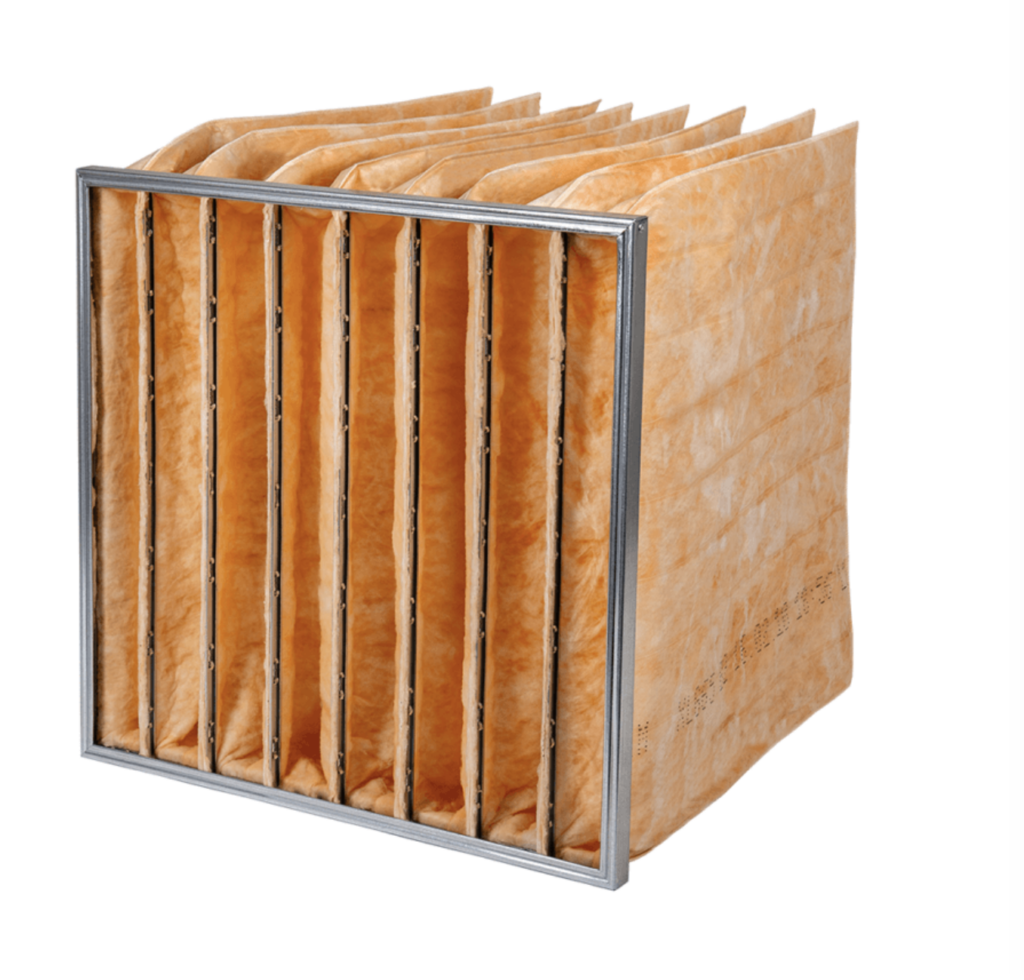
Pocket/Bag Styles: These offer a massive amount of media surface area. Because the air is distributed across deep V-shaped bags, they hold more dust and maintain a lower pressure drop for a longer period. The trade-off is physical size; handling and disposing of bulky, dust-laden bags takes more time and storage space.
Mini-Pleat Cassettes: These use tightly packed accordion folds in a rigid frame. They are compact, light, and can be swapped out in seconds. They are perfect for tight ceiling plenums and reduce landfill volume. However, they hold less total dust weight than a deep pocket filter, meaning you might replace them slightly more often in heavy-dust environments.
Where F7 Air Filter Delivers the Best Return on Investment
Upgrading to an F7 stage is rarely just about compliance; it usually makes financial sense when you calculate the total cost of ownership.
Protecting Expensive HEPA Stages (Hospitals & Cleanrooms)
In healthcare facilities or electronics manufacturing, true HEPA Filter (H13 and above) are expensive to purchase and labor-intensive to replace. Placing an F7 Pocket filter upstream captures the bulk of the particulate mass. Doubling the lifespan of a downstream HEPA bank from 12 to 24 months easily saves thousands of dollars in media costs and minimizes critical system downtime.
Data Centers and Server Rooms
Server environments need clean air to prevent particle buildup on delicate components, but they also watch power usage effectiveness (PUE) metrics closely. Moving from a restrictive F9 filter down to a low-resistance F7 mini-pleat can drop initial pressure resistance by roughly 30 Pa. In a typical 1 megawatt facility, that minor reduction in fan strain can shave up to 2% off the HVAC energy bill while still keeping the space compliant with ISO 14644-1 Class 8 cleanliness.
K-12 Schools and Older Office Retrofits
Many legacy school and commercial buildings run on older AHU designed back when basic, cheap pre-filters were the norm. Upgrading these systems to heavy, high-efficiency media often requires expensive fan motor upgrades. An F7 Air filter fits into the existing static pressure allowances of most standard commercial fans. It cuts fine indoor particle levels by roughly 60% compared to basic pre-filters, helping older buildings hit modern air quality targets without a massive capital overhaul.
Maintenance and Change-Out Strategy
Relying on a static calendar to change filters is an easy way to waste money or choke your fans. The most efficient approach is tracking differential pressure (ΔP).
The industry rule of thumb is to establish your baseline initial pressure drop when the filter is clean, then schedule your change-out when that resistance doubles, or when it hits a hard cap of 200 Pa whichever comes first.
If your facility hooks differential pressure transducers up to a central Building Management System (BMS), you can monitor the trend lines. Setting a caution alert at 1.6 times the initial pressure drop and a final replacement alarm at 2.0 times gives your maintenance team plenty of lead time to schedule work without running the fans at peak resistance.