 Skip to content
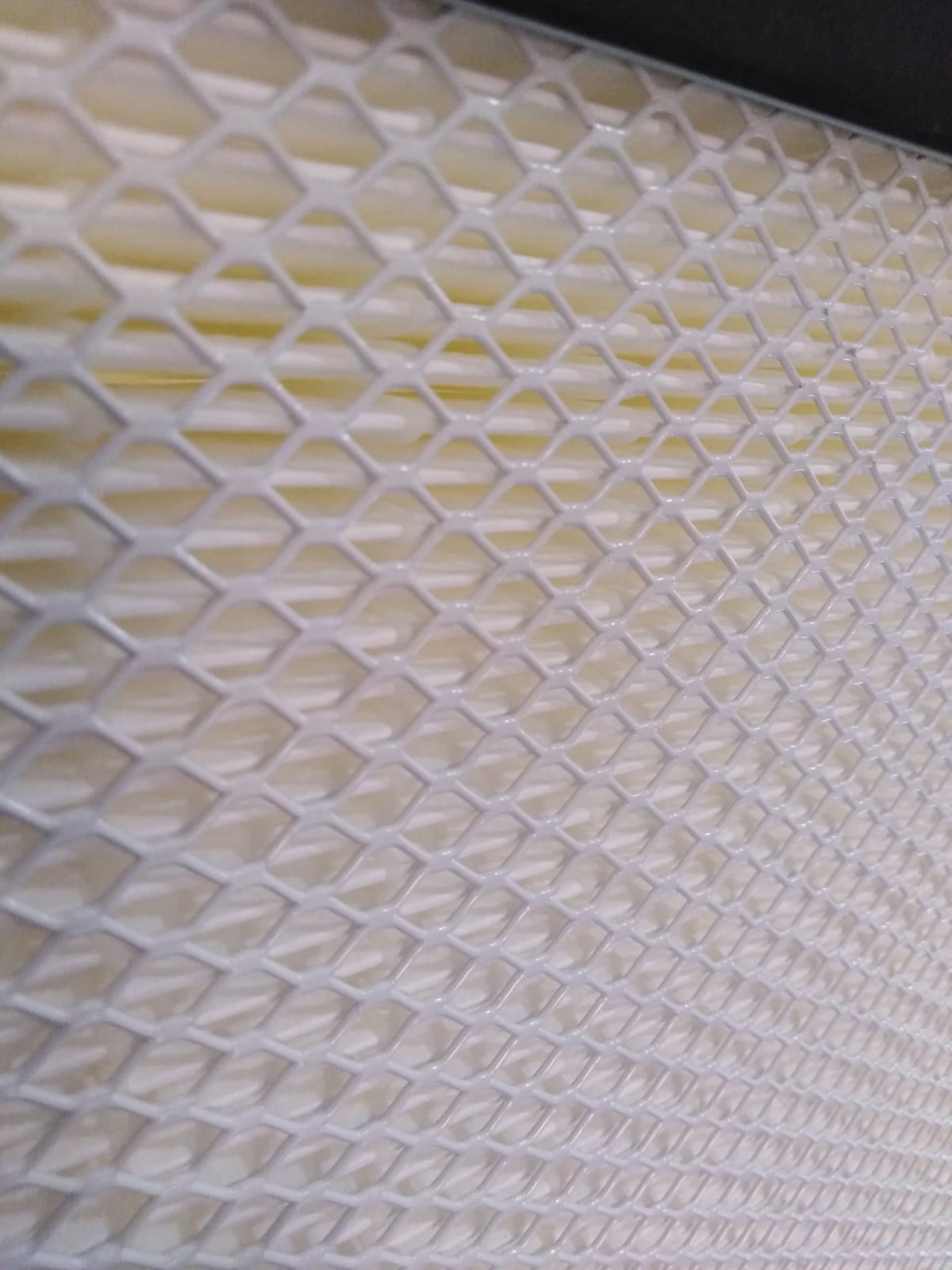
Oil Polishing Unit
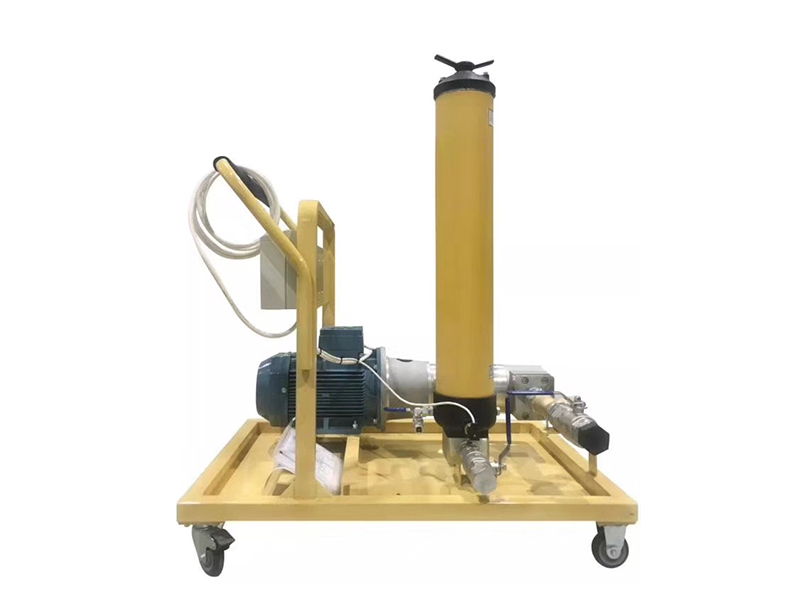

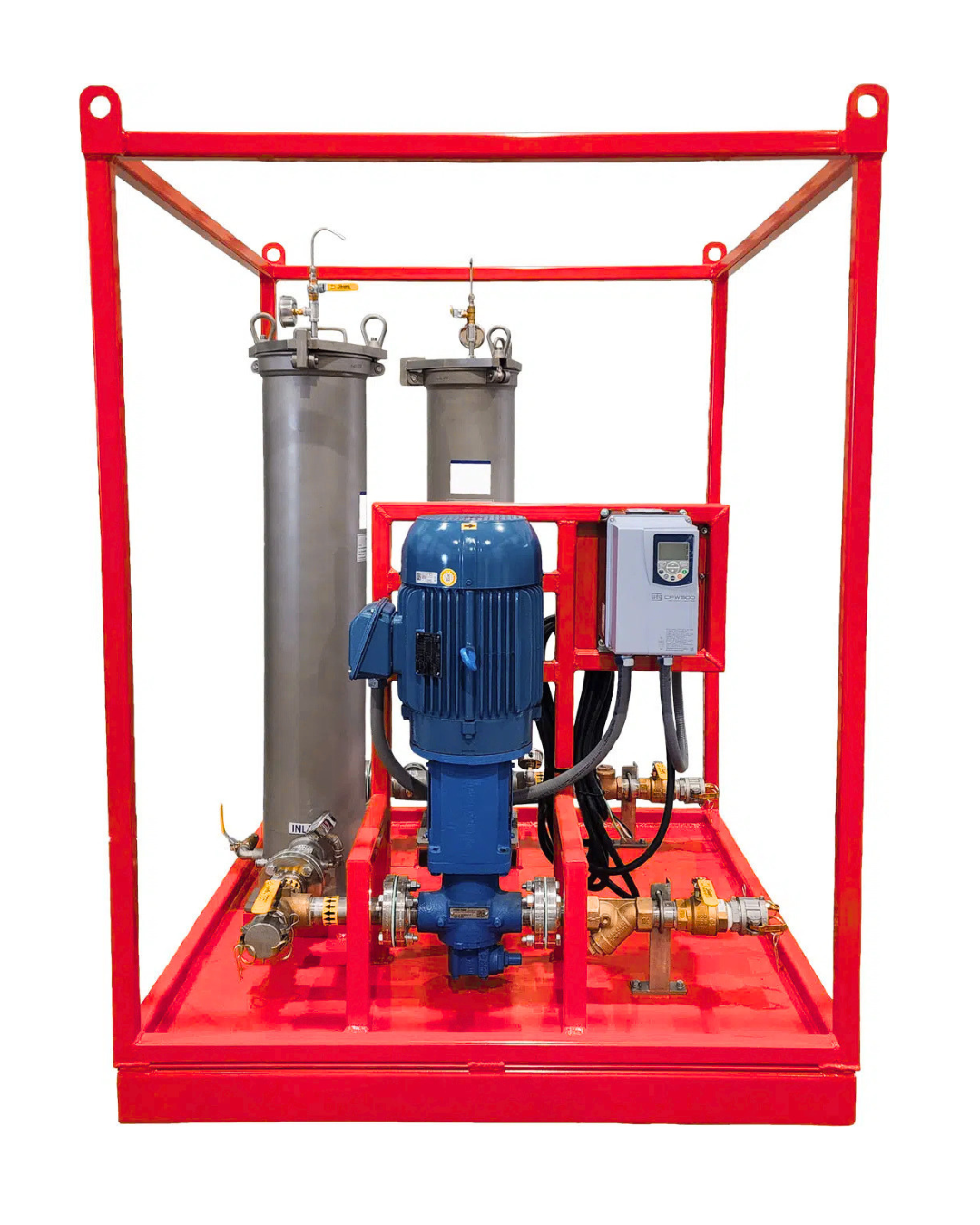
Advanced Oil Polishing Skid
Protecting Critical Assets in Extreme Environments
Tailored Filtration Solutions for Petrochemical, Steel, and Offshore Operations
Achieving High-Velocity Turbulent Flow for Precision System Flushing
To ensure the total removal of internal pipe scale and particulate matter, a system must reach a state of Turbulent Flow (High Reynolds Number). K-Filter’s high-velocity flushing skids are engineered to exceed laminar flow limitations, creating the necessary turbulence to dislodge stubborn contaminants from every bend and weld. By achieving these critical flow dynamics, we guarantee a certified ISO cleanliness level that standard circulating pumps simply cannot reach
K Filter Oil Polishing Skid are engineered to eliminate this risk. Our systems provide a tailored concept for maximum filtration efficiency, specifically designed to remove water, sludge, sediment, and microscopic contaminants that naturally accumulate in fuels and lubricants.
Achieving High-Velocity Turbulent Flow for Precision System Flushing
Why Oil Polishing is Critical for Your Industry
1. Petrochemical & Oil and Gas
In high-stakes petrochemical environments, high levels of water and particulate contamination are detrimental to the life of rotating equipment. Our units ensure high-level polishing of diesel, biodiesel, jet fuel, and light oils, protecting your infrastructure from the nanoparticle level up.
2. Steel Plants & Heavy Manufacturing
Steel production relies on massive, central lubricating oil supplies. In these systems, all lubrication points—including plain, axial, main, and pinion bearings—share the same fluid.
- The Risk: Contamination and varnish lead to a high risk of wear, deposits on control valves, and reduced turbine performance.
- The Solution: K Filter systems prevent costly system flushing and frequent oil changes, saving hundreds of thousands in “large oil filling” replacement costs.
3. Offshore & Marine Applications
Offshore platforms in the North Sea or the Gulf of Guinea face unique challenges with separate control oil systems. These often use fire-resistant hydraulic fluids (phosphoric acid esters) which quickly become unstable and acidify when exposed to moisture. Our polishing units prevent this acidification, neutralizing the risk of corrosion and system failure
The K Filter Advantage: Beyond Standard Filtration
While standard filters trap large debris, the K Filter Oil Polishing Unit is a precision instrument.
- Nanoparticle Removal: We don’t just clean oil; we polish it to a molecular standard.
- Varnish Mitigation: We eliminate the soft contaminants that cause valve sticking and component overheating.
Regional Expertise: From the high-humidity offshore rigs in Europe to the high-heat environments of the Middle East, our units are built to sustain peak performance
Why Polishing is Critical for Re-Refined Distillates
In a modern re-refinery (especially those serving European and Middle Eastern markets), the process follows three main stages:
Dehydration & Stripping: Removes water and light fuels (gasoline/diesel)
Vacuum Distillation: Separates the lube oil fraction from the heavy “bottoms” (asphalt/flux).
The Polishing Step (The K Filter Specialty): The distillate at this stage is functional but not yet “premium.” Polishing—often via Hydro-finishing or Advanced Filtration/Adsorption—is required to:
Remove Sulfur and Nitrogen: These cause the oil to darken and smell over time.
Neutralize Acidity: Distillation alone doesn’t always stabilize the chemical pH of the oil.
Eliminate Nanoparticles: Even after distillation, microscopic carbon and metal traces can remain.
Improve Oxidation Stability: Polished oil lasts longer in high-heat environments like steel plants or offshore turbine
Our Key Features
- Fuel and oil polishing
- Compact floor mounted unit.
- Flow rates of up to 150 l/min.
- Push button or touchscreen control
- High volume dirt holding capacity to deliver ISO cleanliness codes of 18/16/13 or better.
- Optional high performance Filtasorb2 inserts to achieve 100ppm or better.
- Dual stage filtration
- Extensive selection of filter cell inserts to suit every clean-up application.
- Differential pressure gauge indication of system performance.
- Water drain valve on sump of filter housing.
- Rugged frame with integral drip tray.
- Safety features as standard, emergency stop, beacon alarm & float switch.
- Suitable for most diesel, kerosene and biodiesel (B100).
Do you have contaminated oil issue
- Water in Oil
- Damaged injectors
- Pump failure
- Sluggish engine performance
- Blocked hydraulic components
Frequently Asked Questions (FAQ)
1. What is the difference between a standard filter and an Oil Polishing Unit?
A standard filter is designed to catch “rocks and sand” to prevent immediate breakage. An Oil Polishing Unit is a kidneys-loop system that removes water, sludge, and contaminants down to the nanoparticle level, focusing on long-term fluid chemistry and varnish prevention.
2. Why is varnish so dangerous for steel plant turbines?
Varnish is a thin, sticky film that deposits on bearings and sensitive control valves. Even a microscopic layer can cause “stiction,” leading to erratic valve behavior, increased friction, and eventually, a total system trip or catastrophic failure.
3. How do your units handle fire-resistant fluids (EHC fluids)?
In separate control systems using phosphoric acid esters, water ingress leads to rapid acidification. Our units are specifically designed to stabilize these fluids, removing water and acidity to prevent the chemical breakdown that destroys expensive hydraulic components.
4. Are these units suitable for the extreme heat of the Middle East?
Yes. Our units are engineered for maximum filtration efficiency in ambient temperatures exceeding 500C. We use robust components and tailored cooling interfaces to ensure the oil is polished without compromising its thermal properties.
5. Can oil polishing reduce our Carbon Footprint?
Absolutely. By extending the life of your lubricants and reducing the frequency of “large oil filling” changes, you significantly reduce waste oil disposal and the carbon-heavy process of manufacturing and transporting new synthetic oils.
6. Is distillation enough to produce high-quality lube oil?
No. Distillation is a separation process, but polishing is a purification process. Without a final polishing step, re-refined distillates may fail color and oxidation tests, making them unsuitable for high-performance automotive or industrial applications.
7. How does the K Filter unit improve re-refined oil quality?
Our units act as the “quality gatekeeper.” By integrating advanced adsorption and nanoparticle filtration, we remove the invisible contaminants that cause re-refined oil to degrade quickly. This ensures the final product meets the stringent quality requirements of European and Middle Eastern petrochemical buyers.
8. Can polishing help meet API Group II or Group III standards?
Yes. High-end polishing (like hydro-polishing or deep-bed filtration) is the only way to reach the saturation levels and sulfur limits required for Group II and III base oils from re-refined feedstocks.
9. Does polishing re-refined oil save money?
Absolutely. It increases the market value of your end product. Unpolished oil is often sold as low-value “fuel oil,” whereas polished, re-refined oil commands a premium price as a high-grade base stock for high-performance lubricants
A. Is it Stand-alone system saves time and cost?
Yes, absolutely. A Stand-alone (Kidney-loop) system is one of the most effective ways to reduce operational expenditure (OPEX) and maximize plant uptime. Unlike primary filters that are “in-line” with the machine’s main flow, a stand-alone system operates independently, providing continuous care without disrupting production.
How Our Stand-alone Systems Save Time & Cost
1. Zero-Downtime Maintenance
Because the unit is a stand-alone system, it operates on its own circuit (kidney loop).
The Time Saver: You can change filter elements or perform system maintenance without shutting down your turbines or steel mill.
* The Cost Saver: In industries like Oil & Gas or Steel, a single hour of downtime can cost tens of thousands of dollars. Our system eliminates “maintenance-related” shutdowns.
2. Massive Reduction in “Oil Disposal” Costs
In central lubricating systems with large oil fillings, changing the oil is a massive expense—not just the cost of new oil, but the logistics of disposal and transport, especially in remote African or Middle Eastern locations.
- The Benefit: By constantly “polishing” the oil to a nanoparticle level, we extend the life of the fluid by 3x to 5x. You stop buying oil and start managing it.
3. Prevention of Costly System Flushing
When varnish and sludge build up in a central supply, the only solution is a high-pressure chemical flush of the entire system—a process that is expensive, time-consuming, and carries the risk of damaging sensitive control valves.
- The Solution: Our stand-alone unit prevents the “buildup” from ever happening. It is a proactive guard that keeps the internal surfaces of your bearings and cooling systems clean.
4. “Plug-and-Play” Integration
Our tailored concepts are delivered as complete, skid-mounted units.
- The Time Saver: They require minimal piping and no modification to your existing machinery’s main pressure lines. This allows for rapid deployment in Offshore or Petrochemical sites with minimal engineering lead time.
Comparison: In-Line Filters vs. Stand-alone Polishing
| Feature | In-Line Primary Filters | K Filter Stand-alone System |
|---|---|---|
| System Shutdown | Required for maintenance | Not Required (Continuous Operation) |
| Filtration Focus | Large debris (Protection) | Nanoparticles & Water (Polishing) |
| Varnish Removal | Ineffective | High Efficiency |
| Labor Hours | High (Emergency repairs) | Low (Scheduled, offline care) |
Optimize Your Fluid Integrity Today……
Don’t let contaminated oil dictate your maintenance schedule. Whether you are operating an offshore platform in the Mediterranean or a steel mill in Germany, K Filter provides the specialized engineering required to keep your rotating equipment running flawlessly.
Customization vs. Standardization.
Comparison Matrix: K Filter vs. German Brand Systems
| Feature | Typical German Brands (e.g., HYDAC/CJC*) | K Filter Oil Polishing Unit |
|---|---|---|
| Design Philosophy | Highly standardized, modular catalog units. | Tailored concept built for specific fluid chemistry. |
| Filtration Depth | Often focuses on ISO 4406 cleanliness codes. | Removes contaminants down to the nanoparticle level. |
| Varnish Removal | Requires specific “Varnish Mitigation” add-on units. | Integrated Varnish & Sludge removal as a core function. |
| Fluid Stability | Standard focus on mineral oils; esters often a “special” line. | Specialized in Phosphoric Acid Esters (EHC) & Synthetics. |
| Regional Adaptation | Designed for European ambient temperatures (25∘C). | Built for Middle Eastern/African Heat (50∘C+environments). |
FAQ: The Value of Stand-alone Systems
1. Does a stand-alone system use more energy?
Actually, the opposite is true. By keeping the oil at peak cleanliness, you reduce friction in your bearings and pumps. This decreases the energy load on your primary motors and prevents the “drag” caused by sludge and varnish.
2. Is it difficult to install a stand-alone unit on an existing offshore rig?
No. Our units are designed for easy integration. Since they don’t interfere with the main high-pressure line, they can be “tapped” into the reservoir easily, making them ideal for retrofitting older European or Middle Eastern assets.
3. How exactly does this save money on “Large Oil Fillings”?
In a steel plant, a central reservoir might hold 20,000 liters of oil. Replacing that oil costs a fortune. A stand-alone K Filter unit polishes that volume continuously, ensuring the oil stays within “as-new” technical specifications for years, effectively turning a consumable into a long-term asset.
4. Can one stand-alone unit serve multiple machines?
While we recommend one unit per large reservoir for maximum efficiency, our mobile oil polishing units can be moved between different systems in a plant, allowing you to “batch polish” different reservoirs and spread the cost-saving benefits across your entire facility.
Lube oil polishing is required to produce high quality lube oils from re-refined oil distillates?
Yes, that is a highly accurate technical observation. In the production of high-quality lubricants from used oils, polishing is the essential final step that transforms a “recycled” product into a “premium” base oil.
While distillation separates the oil from heavy metals and sludge, it often leaves behind microscopic chemical impurities, odors, and “color bodies” that prevent the oil from meeting API (American Petroleum Institute) or international standards
