Skip to content
F8 Air Filter vs MERV 14: Choosing the Right Filter
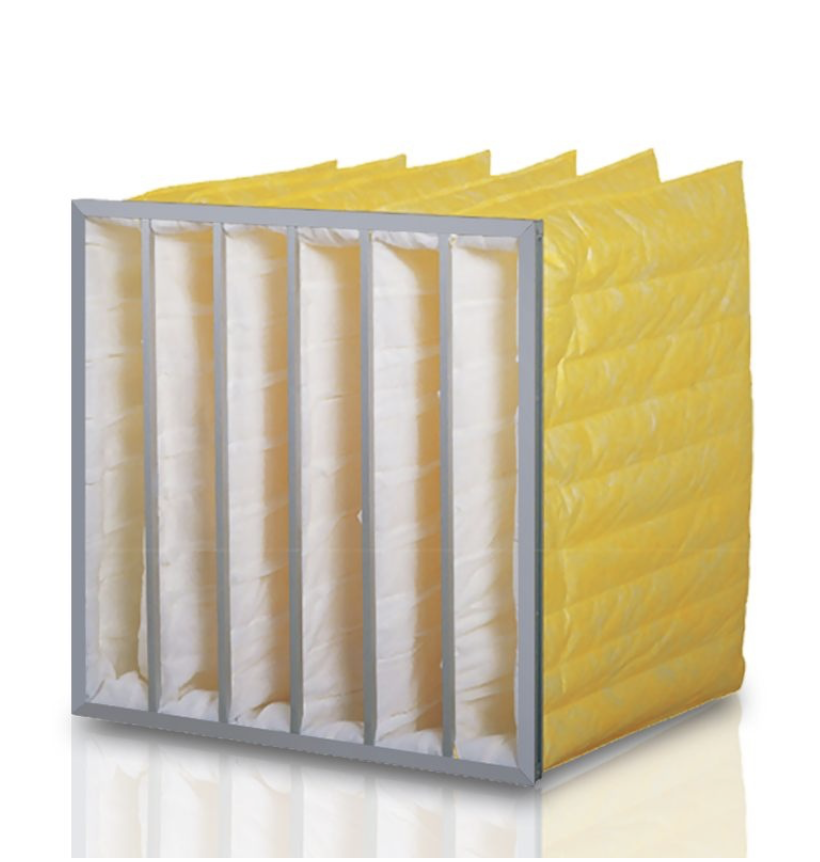
F8 Air Filter – Moving up the efficiency ladder from F7 leads directly to the F8 filter grade. If your facility is dealing with high-density urban air pollution, sensitive manufacturing environments, or strict laboratory requirements, the F8 grade (Fine Pak Bag Pocket Filter) becomes the logical choice.
However, jumping from F7 to F8 isn’t just about catching more dust. It changes how your HVAC systems handle energy consumption and pressure resistance.
Defining the F8 Air Filter Grade: The Standards Comparison
Like its lower-efficiency counterpart, the term “F8” is rooted in the older European EN 779 rating system. In a lab environment under that standard, an F8 Air Filter had to achieve an average efficiency of90% to 95% when capturing 0.4-micron particles.
Today, modern projects specify filters using frameworks that mimic real-world conditions more accurately.
- ISO 16890: Under the current global standard, a standard F8 filter translates to ISO ePM1 70% or ISO ePM2.5 80%. This means the filter successfully blocks at least 70% of the smallest, most dangerous particles under 1 micron, and 80% of particles under 2.5 microns.
- ASHRAE 52.2: For North American specifications, an F8 filter functionally equates to a MERV 14 rating.
This capability to intercept sub-micron particles (ePM1) is the main reason engineers specify F8 filters. They are designed to target fine combustion smoke, bacteria, and microscopic atmospheric dust that lower-grade filters simply let pass through
Technical Performance Metrics
Stepping up to an F8 Air Filter efficiency level means your fan systems will have to work harder. The engineering metrics show a clear shift in performance boundaries:
- Initial Pressure Drop (ΔP): Because the filter media is more densely woven to catch smaller particles, the baseline resistance is naturally higher. A typical F8 Air Filter starts with an initial pressure drop between 90 and 120 Pascals (Pa) at standard face velocities.
- Dust-Holding Capacity: F8 media can fill up faster if it isn’t protected. Because it captures finer soot and sub-micron debris, the dust cake builds tightly on the surface. Depending on the depth of the pleats or pockets, a quality F8 Air Filter will generally hold between 400 and 550 grams of test dust before reaching its terminal pressure limit.
- The Operational Curve: Resistance climbs more steeply in an F8 Air Filter than in an F7. As the filter loads, the static pressure spikes faster, meaning your variable speed drives (VFDs) will ramp up fan power sooner to maintain constant airflow volume.
The Necessity of Multi-Stage Filtration
Running an F8 Air Filter as a standalone single stage is rarely a good idea in commercial air handling units. Because the media is highly sensitive to larger ambient particles, unprotected F8 Air Filter clog rapidly.
To keep maintenance costs under control, a two-stage configuration is the standard practice:
- Stage 1 (Pre-filter): A coarse filter, typically rated at ISO Coarse 60% or MERV Filter 8, is placed at the outside air intake. This stage takes the beating from large insects, pollen, and heavy dust grit.
- Stage 2 (Final filter): The F8 filter is placed downstream of the pre-filter and the mixing plenum. Because the pre-filter removes the heavy particulate mass, the F8 stage can focus exclusively on capturing sub-micron particles, extending its operational lifespan to 6 or even 12 months.
Where F8 pocket filter Are Required
While F7 filters are great for general office spaces, certain applications specifically require the tighter filtration of an F8 media grade.
High-Traffic Urban Offices
Buildings located near major highways, airports, or industrial zones face high concentrations of diesel particulate matter and fine combustion soot. These particles are typically under 1 micron in size. An F7 filter lets about 40% of these sub-micron particles through, while an F8 filter stops at least 70% of them, keeping indoor air safe and preventing walls and ceilings from turning grey near supply diffusers.
Food Processing and Food Packaging
In food production, preventing airborne mold spores and bacteria from settling on open processing lines is critical for shelf-life and safety. Most common bacteria range from 0.5 to 5 microns in size. The ePM1 70% efficiency of an F8 filter provides a reliable barrier against these biological contaminants without requiring the massive energy costs of a full HEPA installation.
Premium Pre-Filtration for Cleanrooms
If your facility uses H14 HEPA or U15 ULPA filters to maintain an ISO Class 5 cleanroom, the cost of replacing those final terminal filters is exceptionally high. Upstream F7 filters let too many fine particles pass, which quickly loads the face of the HEPA media. Upgrading the pre-filtration stage to F8 clean-side filters ensures that the expensive terminal filters only encounter highly polished air, protecting your capital investment.
1. Can I swap an F7 filter for an F8 filter in my existing AHU?
You can physically swap them if they share the same dimensions, but you must check your fan’s static pressure budget first.
An F8 filter has a tighter media weave, which increases the initial pressure drop by roughly 20 to 30 Pascals compared to an F7. If your fan motor is already running near its limit or your system lacks a Variable Frequency Drive (VFD) to compensate for the extra resistance, upgrading to F8 could reduce your total airflow volume below design specifications.
2. What is the exact difference in particle capture between F7 and F8?
The core difference lies in how they handle sub-micron particles under 1 micron, such as atmospheric soot and fine combustion smoke:
- F7 (ISO ePM2.5 65%): Primarily optimized for particles between 1 and 2.5 microns. It only guarantees a capture rate of around 50% to 55% for sub-micron particles.
- F8 (ISO ePM1 70%): Specifically tested and rated to stop at least 70% of sub-micron particles under 1 micron.
3. Do F8 filters require a pre-filter stage?
Yes. Running an F8 filter as a single standalone stage is inefficient and expensive. Because F8 media is highly sensitive, large ambient dust and fibers will clog the outer layer rapidly, causing a sharp spike in static pressure. Using a cheap pre-filter (like a MERV 8 or ISO Coarse 60%) to catch heavy debris allows the F8 filter to focus purely on fine particulate, doubling or tripling its operational life.
4. How do F7 and F8 ratings translate to the North American MERV system?
Because the testing methodologies differ slightly, there is no perfect 1:1 cross-reference, but the functional equivalents used in engineering specifications are:
| European Rating (EN 779) | Global Rating (ISO 16890) | US Equivalent (ASHRAE 52.2) |
|---|---|---|
| F7 | ISO ePM2.5 65% | MERV 13 |
| F8 | ISO ePM1 70% | MERV 14 |
5. Which grade is better for meeting green building standards like LEED or WELL?
For standard commercial offices seeking baseline compliance, F7 (MERV 13) is usually the minimum threshold required to earn credits for enhanced indoor air quality under LEED v4.1 and WELL v2.
However, if your project is located in an urban area where local outdoor air quality monitoring regularly exceeds WHO guidelines for fine particulate matter, upgrading to F8 (MERV 14) is often necessary to safely meet the strict indoor PM2.5 threshold targets.