Skip to content
Air Filtration – When optimizing an HVAC system, two metrics determine your success: Filter Efficiency and System-Efficacy. Understanding the nuance between these two can be the difference between a high-performance building and a costly mechanical failure.
1. Defining Filter Efficiency (The “How”)
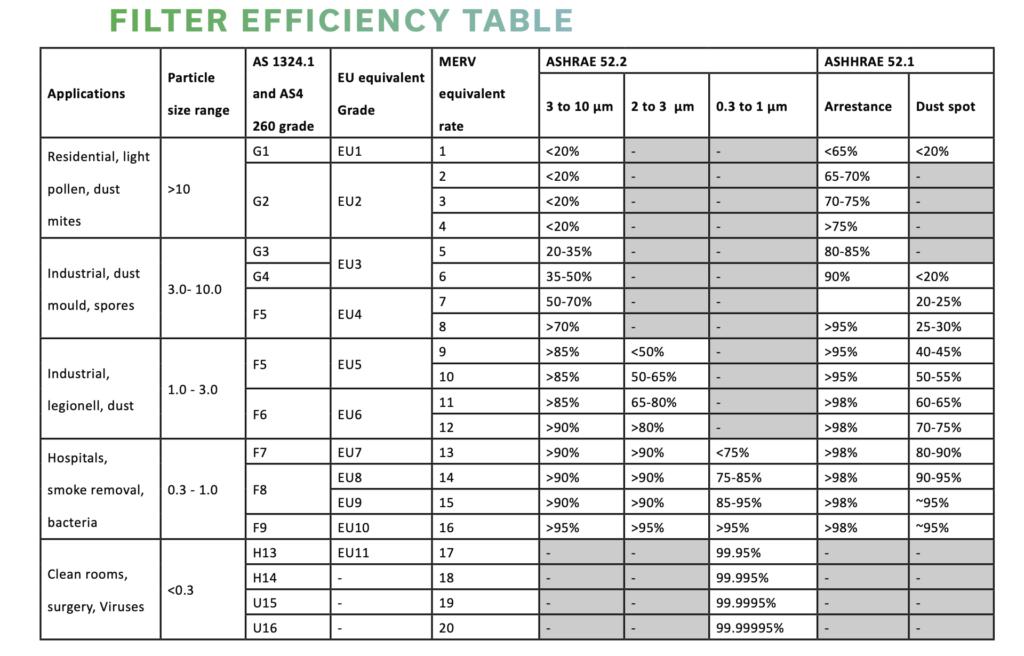
In the context of an F8 pocket filter, efficiency refers to the percentage of particles the media can capture. It is a mathematical ratio of particles entering versus particles exiting.
- The Metric: Measured by standards like ISO 16890 standards (e.g., ePM1 70%).
- The Goal: Maximizing particle capture while minimizing energy consumption.
- High-efficiency air filtration.
An efficient filter captures 95% of 0.4μm particles while maintaining a low pressure drop. If a filter captures particles but forces the fan motor to work at double speed, it may be effective at cleaning air, but it is not efficient for the building’s budget.
2. Defining Filtration-Efficacy of Air Filtration (The “What”)
Efficacy refers to the filter’s ability to produce the desired result in a specific environment. It asks: “Is this filter capable of reaching the air quality target required for this space?”
- The Metric: Measured by IAQ (Indoor Air Quality) sensors and health outcomes.
- The Goal: Meeting safety standards (e.g., surgical suite vs. warehouse).
For example, an F8 pocket filter has high-efficacy in an office setting because it removes allergens and smog. However, it has low-efficacy in a nuclear facility where HEPA-grade (H13) filtration is required to catch radioactive isotopes. No matter how “efficient” the F8 is at its own grade, it lacks the efficacy for that specific high-risk application.
Comparison Table: Efficacy vs. Efficiency of Air Filtration
| Feature | Efficiency | Efficacy |
| Primary Focus | Performance ratio (Input vs. Output). | Result and Suitability. |
| Mechanical Impact | Affects energy bills and fan lifespan. | Affects health standards and compliance. |
| Key Question | “How much dust does it catch per watt?” | “Is the air safe enough for this room?” |
| F8 Filter Example | Capturing 70% of PM1 particles. | Successfully reducing sick building syndrome. |
The “Sweet Spot”: Balancing the Two
The goal of any HVAC professional is to find the Efficacy-Efficiency Equilibrium of Air Filtration.
- Select for Efficacy: Identify the contaminants you need to remove (Smoke? Pollen? Bacteria?). For most commercial spaces, the F8 (ePM1 70%) is the peak of efficacy.
- Optimize for Efficiency: Once the F8 grade is chosen, select a pocket filter with a aerodynamic design to ensure that this efficacy doesn’t come at the cost of high electricity bills.
When searching for your next filtration upgrade, don’t just look for “the strongest filter.” Look for the one that offers the efficacy to protect your occupants and the efficiency to protect your bottom line.
Pro Tip: Upgrading from an F7 to an F8 pocket filter increases your filtration-efficacy against viruses, but you must check the efficiency (pressure drop) to ensure your AHU fan can handle the change.