Skip to content
When you are managing a pipeline system, space is often your rarest commodity. Standard temporary filtration solutions, like standard conical or witch’s hat strainers, work beautifully for trapping construction debris during system startup. However, they have a major limitation: their long, tapered geometry requires a significant stretch of straight, unobstructed pipeline.
If you have a tight physical footprint—such as a pair of flanges situated right before a sharp elbow, a valve, or a pump intake—a standard elongated cone simply will not fit.
A double cone Strainer solves this exact engineering bottleneck. By utilizing a specialized dual-cone profile, it maximizes your internal filtration surface area while dramatically shortening the physical space required inside your pipeline.
This guide breaks down how double cone strainers work, why their unique shape matters for pressure drop management, and how to select the right one for your process.
What is a Double Cone Strainer?
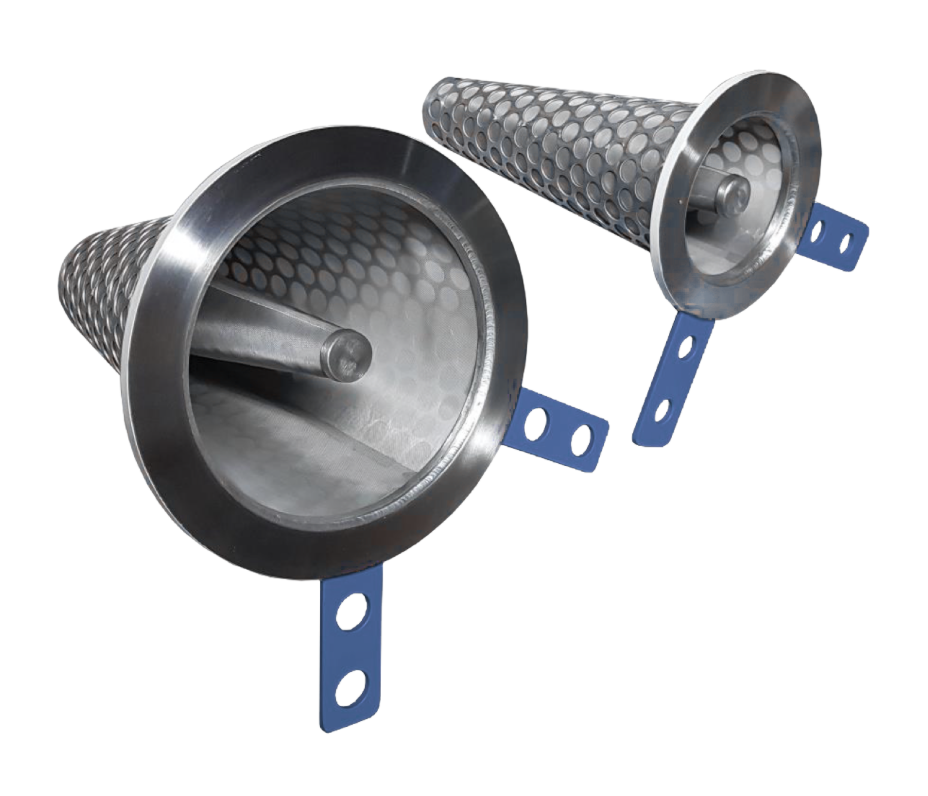
A Double cone Strainer is an inline filtration device manufactured from perforated sheet metal or woven wire mesh. It is designed to be clamped directly between two standard pipe flanges, requiring no external pressure vessel or heavy dedicated outer housing.
The defining characteristic of a double cone strainer is its nested configuration. Rather than extending deep down the length of a single pipe section, the mesh structure curves or nests into a multi-tiered cone layout.
Think of it as splitting the filtration surface across a shorter, more compact framework. This design lets you maintain a massive open area ratio while keeping the physical installation length to an absolute minimum.
The Core Advantages of the Double Cone Profile
When fluids flow through a pipeline, any obstruction creates resistance, resulting in a drop in line pressure. The geometry of a double cone strainer offers distinct operational benefits to manage this issue.
1. Large Free Filter Area in Short Sections
A standard cone strainer requires an extended length to achieve a high open area ratio (the ratio of the mesh holes to the pipe’s internal cross-section). If the pipeline space is short, using a basic flat-top or short cone severely restricts fluid flow, leading to a massive pressure drop. The double cone profile expands the filtration area by 200% to 400% of the pipe cross-section within a fraction of that horizontal length.
2. Low Differential Pressure and Long Service Life
Because the fluid has a much larger surface area to pass through, initial flow resistance is incredibly low. This design also ensures a longer service life during operation. As debris accumulates along the mesh walls, the large surface area prevents the strainer from clogging instantly, preserving your downstream system pressure for longer periods.
3. Critical Equipment Collision Protection
Double cone strainers are widely used as start-up or commissioning filters. When installed upstream of expensive, precision machinery like compressors, turbines, multi-stage pumps, or delicate flow meters, they act as an essential protective barrier against stray welding beads, slag, scale, and installation debris
Technical Considerations for System Selection
Choosing the correct double cone configuration requires matching the component’s mechanical limits to your pipeline’s flow parameters.
Material Selection and Structural Reinforcement
Because these strainers sit directly within high-velocity fluid paths, they face significant physical stress. Standard models are typically manufactured from high-grade stainless steel (such as 304 or 316) to provide exceptional corrosion and erosion resistance.
For fine filtration applications, the strainer utilizes a dual-layer design: a heavy, thick perforated metal core provides the necessary structural burst strength, while a fine wire mesh liner catches small particulates.
Flange Matching and Identification
Double cone strainers are custom-engineered to match specific flange standards, including DIN EN 1092-1 and ASME B16.5 or B16.47. The sealing face of the strainer ring must exactly match your pipe’s gasket configuration, whether you are utilizing a standard raised face (RF), a ring-type joint (RTJ), or a tongue-and-groove layout
Most units feature an elongated handle tab that extends well past the outer diameter of the pipe flange. This tab serves two critical functions:
- It lets operators visually verify that a temporary strainer is currently sitting inside the line.
- It provides a permanent stamping surface for part numbers, line sizing, pressure ratings, and material tracking batches.
Comparing Geometric Strainer Profiles
| Strainer Type | Installation Length Required | Open Area Ratio Range | Primary Operational Advantage |
|---|---|---|---|
| Standard Hat Strainer | Very Short | 150% average | Budget-friendly, simple protection for low-debris lines |
| Conical (Witch’s Hat) | Long to Very Long | 150% to 300% | Exceptional structural strength, excellent for high-volume flushing |
| Double Cone Strainer | Short | 200% to 400% | Maximizes filter area inside tight spaces and piping elbows |
Maintenance and Operational Safety
Like all inline, flange-clamped strainers, double cone variants are typically intended for temporary system startup, line flushing, or process windows where debris is predictable.
To clean or inspect a double cone strainer, the section of the pipeline must be isolated, completely drained, and fully depressurized. Technicians must break the flange connection, pull the pipe faces slightly apart, and lift the unit out by its handle tab.
Because cleaning requires physical pipeline intervention, it is critical to monitor your inlet and outlet pressure gauges closely. A sudden spike in differential pressure across the strainer zone indicates a full basket that requires immediate cleaning to prevent mesh deformation or upstream pump cavitation.
Conclusion
When pipeline space is limited but you cannot afford to compromise on flow rate or equipment safety, a double cone strainer is an ideal compromise. It packs the high surface area of an elongated cone into a compact, space-saving design, ensuring low pressure drop and continuous safety.
If you are currently planning a plant commissioning project, retrofitting a tight piping manifold, or looking for ways to protect downstream valves from scaling, our engineering team can help. Contact us today to specify the exact dimensions, materials, and mesh configurations required for your application.

Frequently Asked Questions
1. What makes a double cone strainer better than a standard conical strainer?
The primary advantage is space efficiency. A standard conical strainer requires a long, straight section of pipe to achieve a high filtration surface area. If you try to shorten a standard cone, you lose surface area, which restricts flow and spikes your pressure drop. A double cone strainer uses a nested, dual-cone shape to deliver up to double the surface area of a standard cone within the exact same short installation length.
2. Can a double cone strainer be used for long-term, permanent filtration?
While they are highly durable, double cone strainers are primarily designed for temporary startup, line flushing, and commissioning phases. Because they are clamped directly between pipe flanges, cleaning them requires shutting down the line, unbolting the flanges, and physically separating the pipes. For permanent applications requiring frequent cleaning, a basket strainer with a quick-opening top cover is much more practical.
3. How do I know which direction to install a double cone strainer?
Installation depends on your specific process goals, but they are most commonly installed with the cone tips pointing downstream (with the flow entering the open side of the cones). This configuration ensures that all captured debris collects inside the nested cones. When technicians remove the strainer, the trapped debris comes out with it, rather than sliding backward into your upstream pipeline.
4. What happens if a double cone strainer gets completely clogged?
If a strainer is left uncleaned during heavy debris loading, the differential pressure across the mesh will spike rapidly. This can lead to two major problems:
- Pump Cavitation: The restricted flow starves downstream pumps, causing severe mechanical vibration and damage.
- Structural Collapse: If the pressure exceeds the structural limits (burst strength) of the perforated metal core, the strainer can tear or collapse, sending both the captured debris and sharp fragments of metal straight into your expensive downstream equipment.
5. What information is usually stamped on the handle tab of a double cone strainer?
The extended handle tab is designed to remain visible outside the pipe flanges. Manufacturers typically stamp it with critical tracking and safety data, including:
- Nominal pipe size (e.g., 8 inch / DN200)
- Pressure rating class (e.g., Class 150 / PN16)
- Material type (e.g., 316 SS)
- Perforation or mesh size
- Unique manufacturing batch or heat number for material traceability