Skip to content
Managing Impregnated Media and Ash Accumulation Thresholds
Activated Carbon – When managing large-scale industrial water or odor control assets, the lifecycle cost of your filtration media dictates a significant portion of your operational budget. For systems like K filters and Deep Bed Air Scrubber Purifier carbon adsorbers, there always comes a point where the spent activated carbon loses its effectiveness. When performance drops, you face a straightforward operational choice: pull the spent media and replace it with virgin carbon, or send it out for thermal regeneration.
From an engineering and asset management standpoint, this decision is rarely a simple calculation of the price per metric ton. It requires balancing residual performance degradation against supply chain risks and system compatibility.
The Mechanical Reality of Regeneration
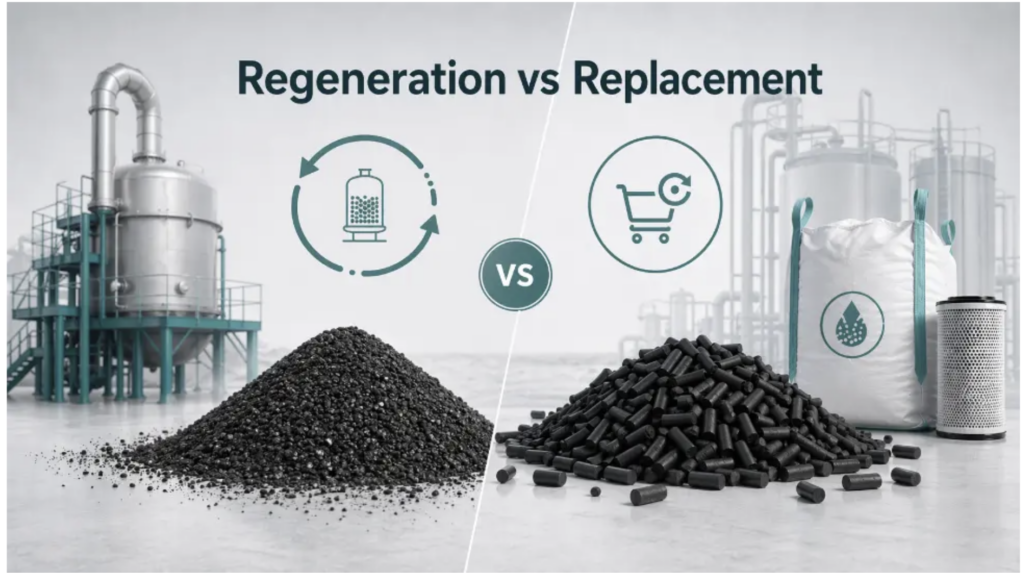
Thermal regeneration relies on high-temperature kilns—usually rotary or multi-hearth setups operating between 800°C and 900°C—to pyrolyze and oxidize the adsorbed organic contaminants. While this effectively clears the pore structure, the process modifies the physical structure of the carbon itself.
Each thermal cycle causes a localized loss of the carbon substrate, typically resulting in a 5% to 10% material loss per run. To make up for this deficit, facilities must blend virgin carbon into the reactivated batch. Furthermore, the high heat slightly alters the pore size distribution. Over multiple cycles, a portion of the highly efficient micropores transitions into larger mesopores. For general odor control or heavy organic water treatment, this shift may be negligible. However, if your K filter is tuned for trace contaminant polishing, this subtle drift in pore architecture can lead to faster breakthrough times.
Financial and Risk Assessment
Evaluating the economics requires looking beyond the initial invoice for media delivery. A comprehensive assessment must account for the following three areas:
- Total Cycle Costs: Virgin carbon carries higher upfront capital costs along with vulnerable price stability tied to raw materials like coal or coconut shell. Regeneration offers a lower per-ton cost, but you must factor in the round-trip logistics, the cost of the virgin make-up carbon, and the energy footprint of the transport.
- Contaminant Cross-Contamination: If you utilize custom or pooled reactivation services, your spent carbon is processed in kilns that handle waste streams from various industries. For critical water treatment applications with strict regulatory thresholds, the risk of trace cross-contamination from other spent batches must be strictly managed or mitigated through dedicated, segregated reactivation runs.
- Media Mechanical Strength: Every handling and thermal cycle introduces mechanical stress, which degrades the hardness of the granules. If the carbon structure breaks down into fines, you will see an immediate increase in the differential pressure across your K-filter beds, leading to premature backwashing cycles or potential carbon carryover into downstream processes.
Establishing the Decision Framework
For standard applications handling high volatile organic compound (VOC) concentrations or heavy industrial wastewater loading, regeneration provides a highly sustainable, cost-effective closed-loop system. The lower cost per pound easily justifies the minor shifts in adsorption kinetics.
Conversely, if your system operates as a final polishing step for highly toxic, low-molecular-weight compounds, the predictability of virgin carbon often outweighs the savings of reactivated media. When maximum micro-porosity and strict quality control are non-negotiable, replacing the media entirely remains the most reliable path to safeguarding your effluent or discharge quality.
Frequently Asked Questions
1. What is the typical loss of adsorption capacity after a single thermal regeneration cycle?
A single thermal regeneration cycle generally results in a 5% to 15% drop in specific surface area and iodine number. This loss is caused by a combination of residual ash accumulation (which blinds the pores) and the partial collapse of the delicate micropore structure during high-temperature kiln processing.
2. How does thermal reactivation alter the physical pore structure of the carbon?
The high-temperature steam or carbon dioxide environment in the kiln preferentially burns away carbon walls within the particle. This turns a portion of the high-energy micropores (less than 2 nm) into larger mesopores (2 to 50 nm). While this can actually improve the carbon’s kinetics for capturing larger organic molecules, it permanently reduces its capacity for trace, low-molecular-weight volatile organic compounds (VOCs).
3. What is the difference between custom/segregated reactivation and pooled reactivation?
- Custom (Segregated) Reactivation: Your specific spent carbon is processed alone in a dedicated kiln run and returned to you. This is mandatory for systems treating highly toxic or strictly regulated streams to prevent liability and cross-contamination.
- Pooled Reactivation: Your carbon is mixed with spent carbon from various other industries. You receive an equivalent volume of reactivated carbon back from the general pool. This option is cheaper but comes with a higher risk of ash variation and trace contaminant carryover.
4. Why are chemically impregnated carbons difficult or impractical to regenerate?
Impregnated carbons (such as those treated with sulfur, iodine, or copper for mercury and hydrogen sulfide removal) do not react well to standard thermal regeneration. The high kiln temperatures vaporize or destroy the chemical impregnate, rendering them useless. Furthermore, these chemicals can corrode the kiln lining or create hazardous emissions during processing. Specialized chemical or thermal processes are required, which often makes replacement more cost-effective.
5. How do carbon fines from regenerated media affect K-filter or deep-bed operational hydraulics?
Thermal and mechanical stress during handling creates fine carbon particulates. If these fines are not thoroughly screened out before reloading the vessel, they migrate through the bed and lodge in the interstitial spaces between larger carbon granules. This significantly increases the bed’s differential pressure (ΔP), accelerates channeling, and can cause particulate carryover into the treated water or air stream.
6. At what point does ash accumulation render activated carbon completely unreactivable?
When the total ash content of the carbon bed reaches 12% to 15% by weight, thermal reactivation is no longer viable. High ash levels (caused by trapped inorganics, calcium, or heavy metals) act as a physical barrier over the pore openings. In the kiln, excessive ash can also catalyze the oxidation of the carbon skeleton itself, causing the material to structurally disintegrate into unusable powder.